Data storage and ownership
Overview
Dialogue Cloud Neo processes and stores data in different locations depending on the data type and the services used. This page separates the current Dialogue Insights data platform from deployments that include customer-owned Azure SQL Database instances.
For a more comprehensive and up-to-date building block overview, see the Architecture pages on this site, Learn More
Dialogue Cloud Neo data journey
In Dialogue Cloud Neo, customer and service data is separated between the AnywhereNow-managed Azure tenant A dedicated and trusted instance of Azure AD. The tenant is automatically created when your organization signs up for a Microsoft cloud service subscription, such as Microsoft 365. An Azure tenant represents a single organization. [Taken from Microsoft Docs] and the customer's Microsoft 365 or Azure tenant.
-
UCC A Unified Contact Center, or UCC, is a queue of interactions (voice, email, IM, etc.) that are handled by Agents. Each UCC has its own settings, IVR menus and Agents. Agents can belong to one or several UCCs and can have multiple skills (competencies). A UCC can be visualized as a contact center “micro service”. Customers can utilize one UCC (e.g. a global helpdesk), a few UCC’s (e.g. for each department or regional office) or hundreds of UCC’s (e.g. for each bed at a hospital). They are interconnected and can all be managed from one central location. setup management, primary configuration, and logging data is accessible through OnePortal Formerly known as Partner Portal. A redesigned web portal for managing Dialogue Cloud deployments. and stored in the AnywhereNow-managed Azure tenant.
-
UCC behavior management and audio file storage are stored in UCC-specific SharePoint Online sites in the customer's Microsoft 365 tenant.
-
UCC advanced management, such as integrations and custom workflows, is accessible through Dialogue Studio and stored in the AnywhereNow-managed Azure tenant.
-
Call Detail Records (CDR Call Detail Records (CDR) are the meta data of a converstation: who talked to whom, at which time, for how long and with which identity among other things (skill, optional classification, etc) which gets stored in your SQL (analytical) database.), historic dialogue data, and realtime events used by Dialogue Insights are stored in customer-specific Microsoft Fabric resources in the AnywhereNow-managed Azure tenant.
-
Text channel content, such as email and WebChat conversation content, is stored in a customer-hosted Azure SQL Database when those Dialogue Manager channels are part of the deployment.
Dialogue Insights
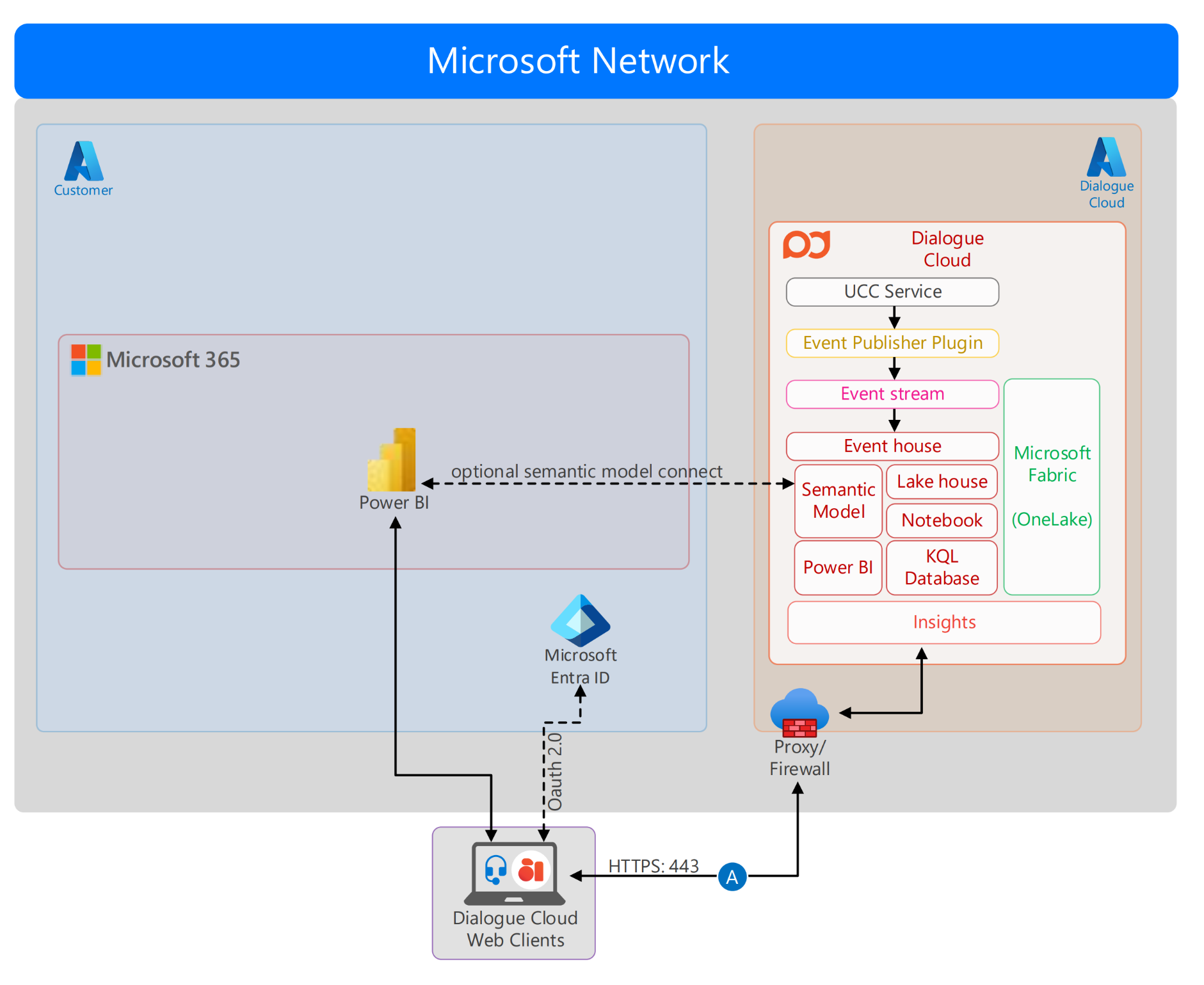
Dialogue Insights is the historical analytics and reporting platform for Dialogue Cloud Neo. It provides a governed data source for historical reporting and uses Microsoft Fabric for customer-specific event streams, Eventhouse databases, semantic models, and report workspaces. Dialogue Insights uses the CDR data hosted in Microsoft Fabric, not a customer-owned CDR database. For more information, see Dialogue Insights and Dialogue Insights data residency and processing regions.
Customer-owned storage and data
Note
Customer Call Detail Records (CDR) database availability depends on the deployment model and onboarding path:
-
Existing customers upgrading to Dialogue Cloud Neo, for either Dialogue Cloud Neo (Connect) or Dialogue Cloud Neo (Unify), can continue using their existing customer-owned CDR database together with Dialogue Insights. Reports for that customer CDR database are displayed in Power BI by using a Power BI template provided by AnywhereNow. This customer CDR database is not used by Dialogue Insights.
-
New customers onboarding to Dialogue Cloud Neo, for either Dialogue Cloud Neo (Connect) or Dialogue Cloud Neo (Unify), use Dialogue Insights only. A customer-owned CDR database is not supported for these new deployments.
We encourage all customers to adopt Dialogue Insights.
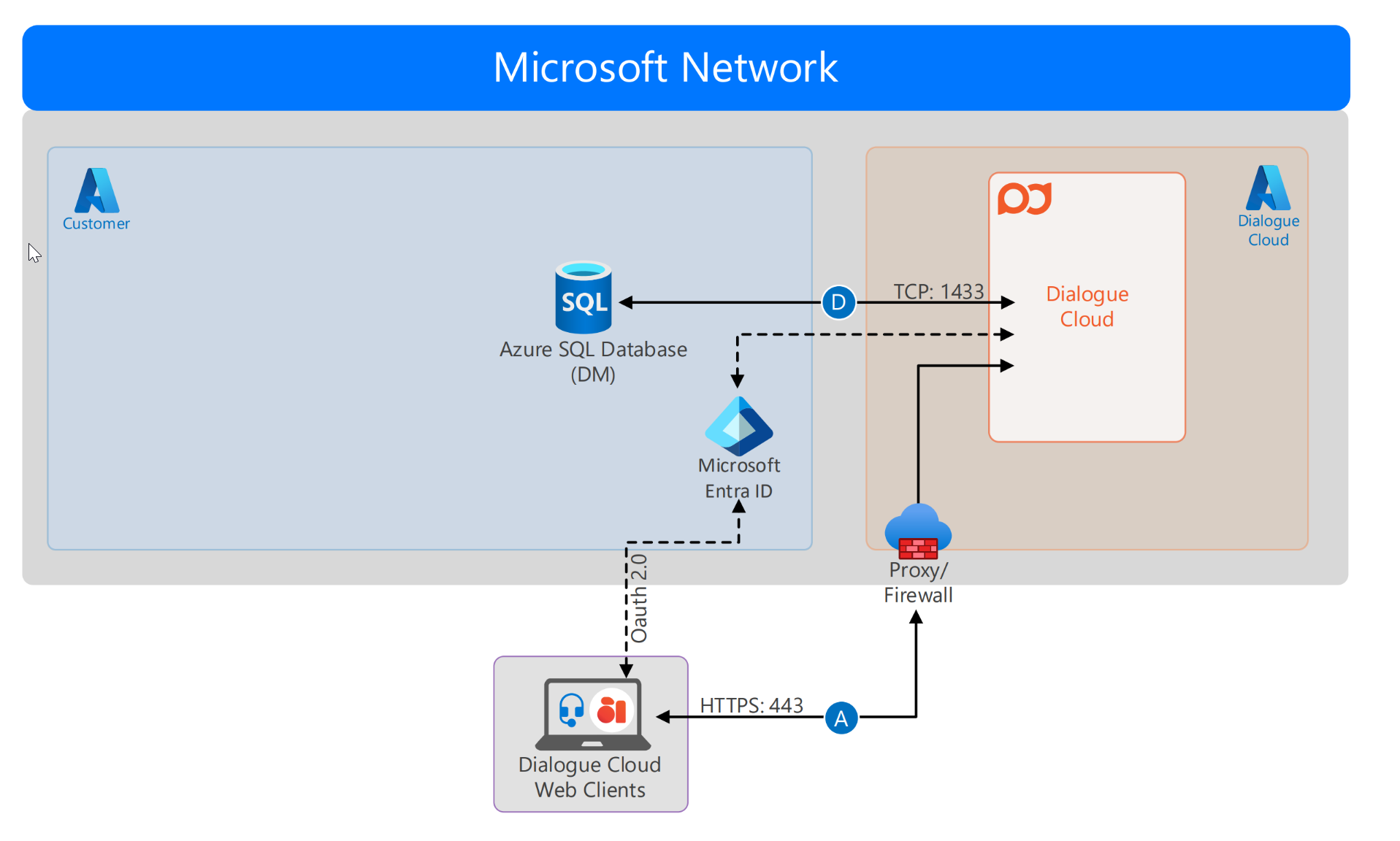
The picture above is a schematic overview for deployments that include customer-owned Azure SQL Database instances. It is a high-level visual representation of the architecture, including external components managed by the customer or a partner. It does not represent the Dialogue Insights data platform.
Use the following information only when customer-owned Azure SQL Database instances are part of the deployment, such as for customer-owned CDR database storage with Power BI reporting or Dialogue Manager text channel storage.
Where existing customer databases are part of the deployment, Call Detail Records (CDR) and Dialogue Management (DM AnywhereNow Dialogue Manager (DM) is the internal service which processes text based messages from various Dialogue Providers to and from WebAgent. It is a transactional database used to swiftly process messages rather than generate reports used by analytical databases.) text message transactions, such as emails, WebChat, text messages, or WhatsApp message content, are stored in their respective Azure SQL Database instances residing in the tenant of each customer. Similarly, the SharePoint for Microsoft 365 sites required for configuration management of Unified Contact Centers (UCCs) are deployed in the Microsoft 365 tenant of each customer. Optionally, data retrieved from a connected customer relationship management (CRM Customer Relationship Management, or CRM, is (usually) a software-based, data management method to deal with interactions with customers and potential customers.) partner is only read, through protected APIs, for display in WebAgent. This read data remains in the CRM platform tenant of the customer. Through customization, Dialogue Studio could be configured by a customer to also write to their CRM platform.
For this customer-owned database model, end-customer data is stored in the customer's own tenants. Maintenance, connectivity, regular monitoring, fit-for-purpose sizing and performance, and ownership of this data and these databases remain the full responsibility of the end customer.
For data stored in customer-owned databases, AnywhereNow acts only as processor of the data of the end customer. AnywhereNow will ensure that any personal data belonging to the end customer is processed and stored on dedicated virtual infrastructure controlled by the end customer within their Microsoft 365 and Azure tenant, and optionally CRM, provided the connectivity and performance of the data storage platform matches the requested load. This guarantee is only possible if AnywhereNow is technically capable to process, connect, send, and release the customer's personal data.
Note
After Go-live, maintenance and regular monitoring of the database(s) is the customer's responsibility.
 Read more
Your database(s) will accrue data for every conversation and will grow with use over time, or your final UCC count and configuration may be heavy on DB processing (many simultaneous dialogues in queue, frequent queries from PowerBI or e-mails with large attachments for example), so your maintenance (like monitoring size, adding additional archiving databases, deleting old data, reclaiming unused space or maybe even upgrade to a higher tier or storage) may be required. For more information on Azure SQL limits, pricing and maintenance tips a good starting point is https://learn.microsoft.com/en-us/azure/azure-sql/database/resource-limits-dtu-single-databases, or consult your SQL DB Administrator.
Note
At least one additional Azure SQL database is required when you are using the WebAgent in combination with the DialogueManager for Webchat or e-mail or other DialogueProviders (a.k.a. the DialogueManager database).
Note
Further additional Azure SQL databases are required for every additional UCC service deployed in another global region (APAC, AMER EMEA), for archiving older data, or if one or more UCC's need to collect their CDR's in a private Database.
For more information about connecting to Azure SQL, see: How to connect to Azure SQL