Dialogue Insights - Historic Reporting Dialogue Overview
Introduced in DC2025.02a - Arnhem (Dialogue Cloud Neo)
The Dialogue Overview report lists all dialogues over the past days, months or years..
Note
The report and its dataset gets refreshed every day at 00:30 of the timezone where your Fabric workspace resides.
(Any report open in your browser while the underlying dataset has refreshed, must be manually refreshed in the app for the new dataset to become visible).
 Timezones and Fabric Regions vs. UCC Service Regions
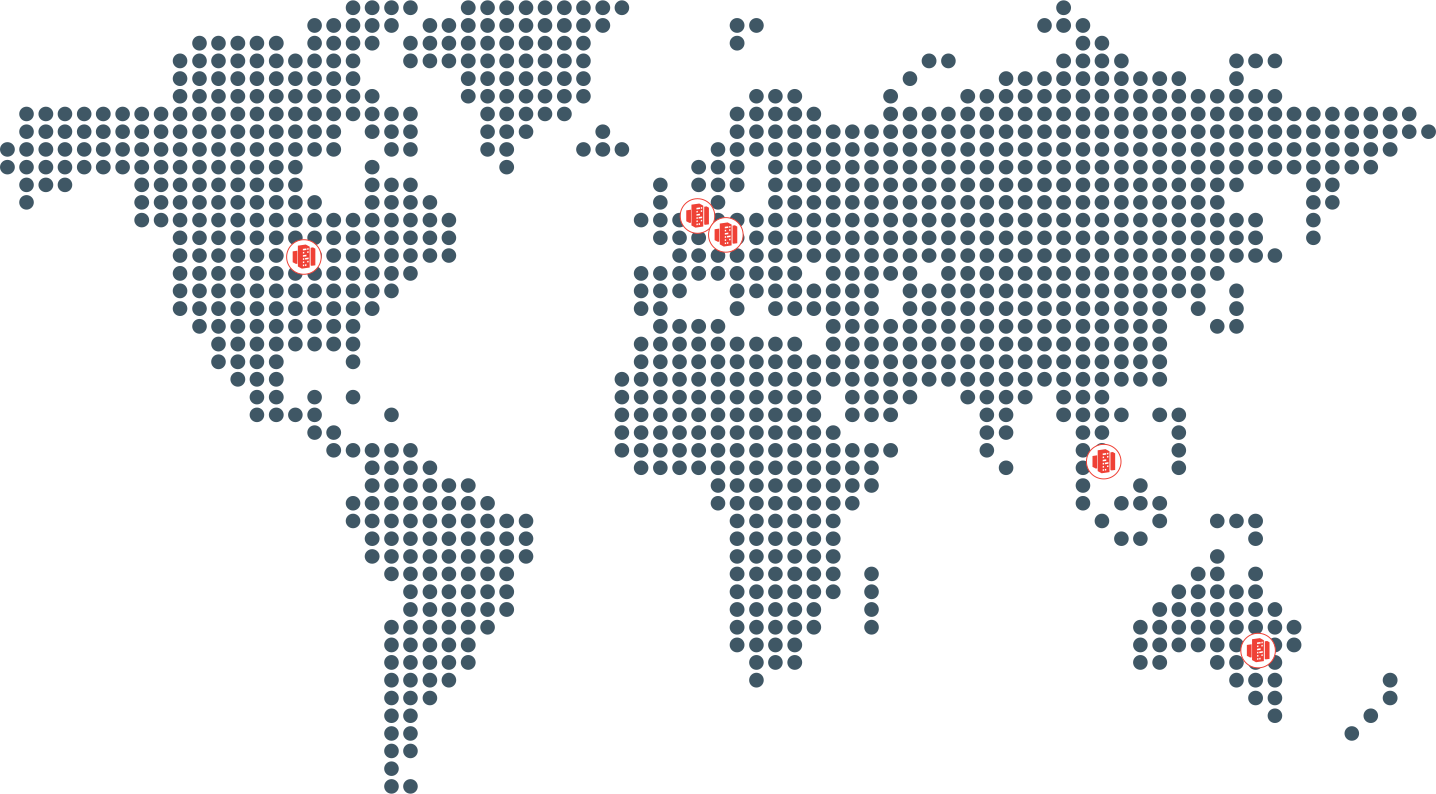
The three possible regions where Fabric workspaces reside (defined by UCC A Unified Contact Center, or UCC, is a queue of interactions (voice, email, IM, etc.) that are handled by Agents. Each UCC has its own settings, IVR menus and Agents. Agents can belong to one or several UCCs and can have multiple skills (competencies). A UCC can be visualized as a contact center “micro service”. Customers can utilize one UCC (e.g. a global helpdesk), a few UCC’s (e.g. for each department or regional office) or hundreds of UCC’s (e.g. for each bed at a hospital). They are interconnected and can all be managed from one central location. Service deployment in Dialogue Cloud Neo) are:
-
EMEA-GWC: W. Europe Standard Time
-
APAC-SEA: Singapore Standard Time
-
NORA-CUS: Central America Standard Time
The mapping of which Fabric workspace region is used by which UCC Service region is provided in table below
| If UCC Service region is: | Then Fabric workspace region is: |
|---|---|
| EMEA-WEU (West Europe) | EMEA-GWC - Germany West Central |
| EMEA-GWC (Germany West Central) | EMEA-GWC - Germany West Central |
| EMEA-SZN (Switzerland North) | EMEA-GWC - Germany West Central |
| NORA-CUS (Central US) | NORA-CUS - Central US |
| APAC-SEA (South East Asia) | APAC-SEA - South East Asia |
| APAC-AUE (Australia East) | APAC-SEA - South East Asia |
For more information, see Dialogue Insights data residency and processing regions.
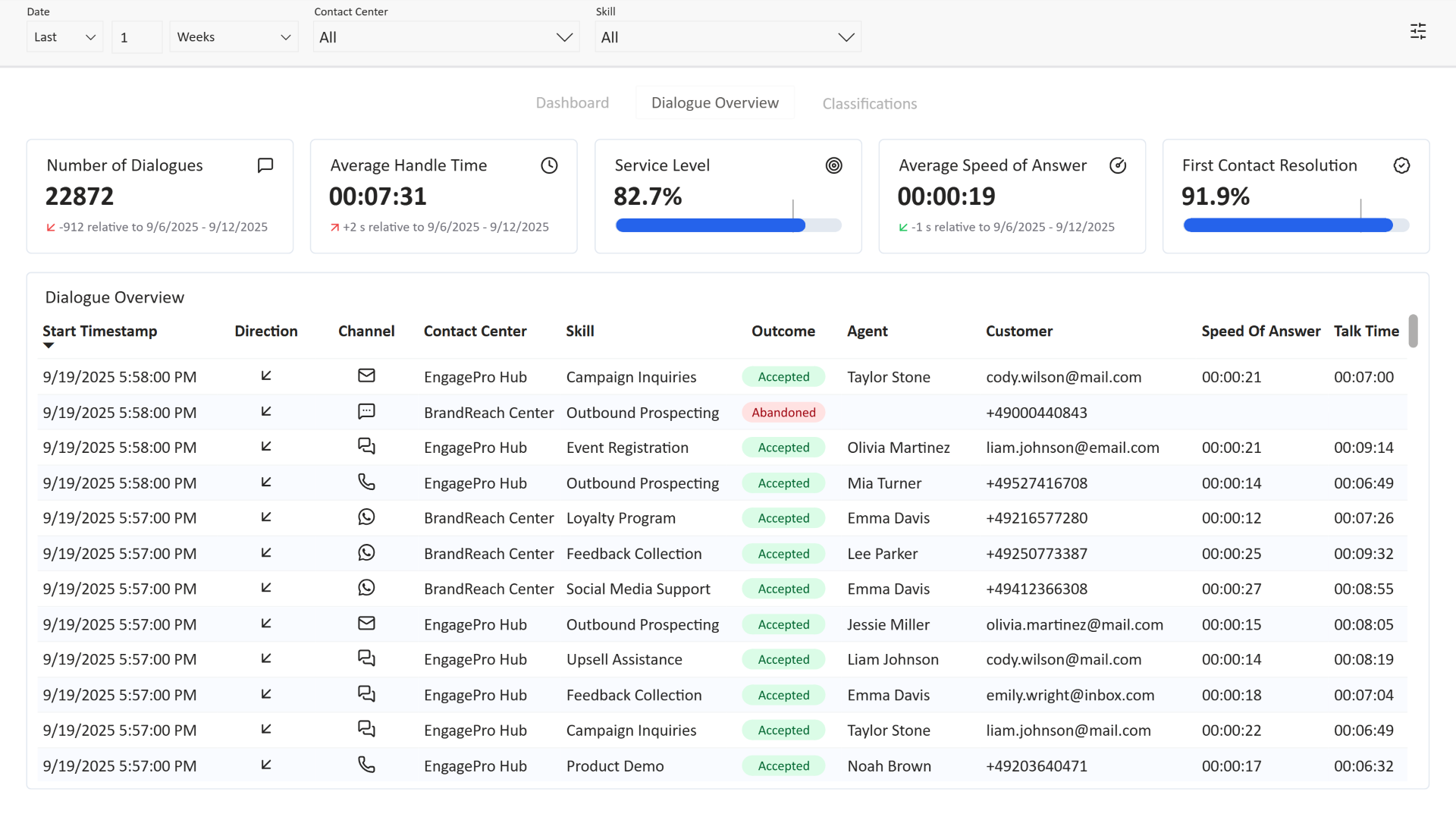
This report includes:
Table
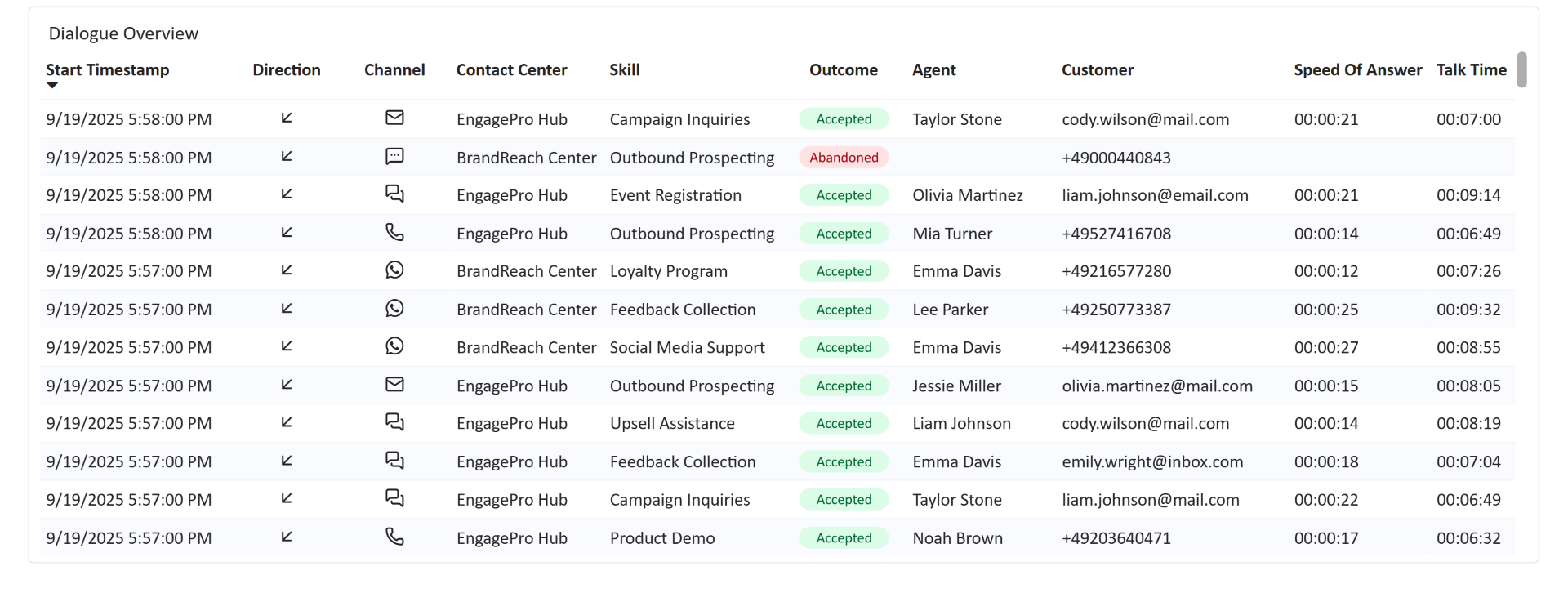
The dialogue overview report contains a table with all dialogues.
Dialogue Overview
For each dialogue the following details are displayed:
-
Start Timestamp: the timestamp when the dialogue was initiated (by the customer for inbound dialogues, or by the agent for outbound dialogues)
-
Direction: the direction of the dialogue (↙️ inbound or ↗️ outbound)
-
Channel: the channel of the dialogue. The following channels are available:
- Chat
- Phone
- SMS
- If it is none of the above an icon with a question mark is shown.
-
Contact Center: the name of the contact center on which the dialogue was received/initiated.
-
Skill: the name of the skill associated with the dialogue.
-
Outcome: the outcome of the dialogue. Today the following outcomes are distinguished:
- Abandoned: the customer ended the dialogue while it was waiting in the queue for an Agent to answer the dialogue.
- Accepted: an Agent answered the dialogue.
- Forwarded: the dialogue is forwarded to an alternative destination before an Agent answered and the customer has not ended the dialogue.
- IVR Interactive Voice Response, or IVR, is a telephone application to take orders via telephone keypad or voice through a computer. By choosing menu options the caller receives information, without the intervention of a human operator, or will be forwarded to the appropriate Agent. Drop: the customer ended the dialogue before a skill was assigned to the dialogue (e.g. while being in the IVR or while the Welcome Message is played).
-
Sentiment: a smiley indicating the sentiment of the Dialogue.
If the feature is enabled, the sentiment is determined only for audio dialogues that have transcripts available. Please note, sentiment is generated post call on 15 minute intervals. It could take a bit longer for sentiment to show up in the report.
-
positive
-
neutral
-
negative
-
-
Agent: the agent who answered/initiated the dialogue
-
Customer: the customer who initiated/received the dialogue
-
Talk time: the time between the moment the agent/customer answered the dialogue and the moment the dialogue is disconnected by all participants.
Sentiment is generated using built-in functionality in MS Fabric; for more details see: Transform and Enrich Data with AI Functions - Microsoft Fabric
Dialogue Details
If you are interested in additional details of a specific dialogue, you can select the dialogue in the Dialogue Overview table.
The button at the top of the table will change from disabled

to enabled

When you click the enabled button, it will bring you to the Dialogue Insights - Historic Reporting Dialogue Details.